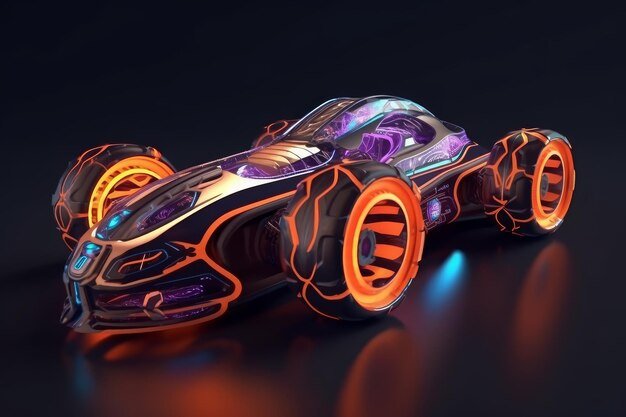
The roar of an engine, the blur of speed, the heart-pounding race to the finish line – these are timeless thrills. But what if those engines hummed with anti-gravity energy, the speed broke the sound barrier without friction, and the tracks twisted through impossible dimensions? That's the electrifying promise of futuristic racing, a genre where Futuristic Racing Tech & Vehicle Lore isn't just window dressing; it's the very core of the experience, pushing gaming's iconic speedsters into realms of pure imagination and adrenaline. These aren't just vehicles; they're technological marvels, each with a unique identity born from advanced engineering and often, a storied history within their digital worlds.
From the pioneering hovercrafts of yesterday to the hyper-customizable combat racers of today, this genre continuously reinvents speed, challenging players not just with reflexes, but with an understanding of complex, often fantastical, physics and ingenious machinery.
At a Glance: Propelling into Tomorrow's Races
- Beyond Wheels: Discover how anti-gravity and hydro-jet propulsion systems redefine speed and movement on the track.
- The Power of Lore: Understand how unique vehicle backstories, team affiliations, and futuristic settings enrich the racing experience.
- Technological Arsenal: Explore the diverse array of weapons, shields, and trick mechanics integrated into futuristic vehicles.
- Impossible Tracks: Learn about the dynamic, often gravity-defying environments that serve as the battlegrounds for these speed demons.
- Evolution of Speed: Trace the genre's journey from early arcade pioneers to today's highly customizable and competitive titles.
- The Future is Now: See how modern games offer varied experiences, from pure skill-based racing to intense combat-driven challenges.
The Core Thrill: What Defines Futuristic Racing?
The futuristic racing genre carves out a unique niche by taking the fundamental mechanics of arcade racing and thrusting them into a speculative, high-tech future. This isn't your grandfather's Sunday drive; it's a genre that thrives on breaking conventional limits. At its heart, futuristic racing often abandons traditional wheeled vehicles for anti-gravity propulsion, allowing for speeds and track designs that would be impossible with tires.
This exciting subgenre first captivated audiences in the late 1980s and early 1990s with trailblazers like Atari Games' S.T.U.N. Runner and Nintendo's groundbreaking F-Zero. These titles laid the groundwork for what would become a highly successful lineage, perhaps most famously cultivated by the WipEout franchise. The genre hit a significant popularity peak around 1999, notably with Star Wars Episode I: Racer selling over 3 million copies, proving a massive appetite for these high-speed, high-concept experiences. Even with the dissolution of WipEout developer Studio Liverpool in 2012, the spirit of futuristic racing endures, with new and innovative titles like Shin'en Multimedia's Fast series continuing to achieve moderate success and push the boundaries of speed.
Decoding Futuristic Vehicle Tech: Engines of Tomorrow
The vehicles are, without a doubt, the stars of any futuristic racing game. They aren't just models; they're engineering marvels, each boasting unique technologies that dictate their handling, speed, and strategic potential.
Hovercraft & Anti-Gravity Systems: The Bedrock of Speed
The most iconic piece of futuristic racing tech is the anti-gravity system, which allows vehicles to glide inches above the track, eliminating friction and enabling blistering speeds. Games like Redout 2 exemplify this, putting you in ultra-fast hoverships on gravity-defying tracks, demanding precision control as you manage velocity and direction. Each of the 70 unlockable hovercars in some titles offers a unique driving experience, with distinct physics influenced by their simulated gravity, weight, and maximum speed. This meticulous balance transforms pure speed into a ballet of calculated risks.
For instance, Pacer emphasizes the nuances of these systems, allowing players to choose from four speed classes that push vehicles from a rapid 400 km/h to an eye-watering 1000+ km/h. This isn't just about faster engines; it's about mastering vehicles designed to operate at extreme tolerances, where a millisecond decision can mean victory or vaporized wreckage.
Hydro Jets & Aquatic Prowess: Mastering the Waves
Not all futuristic racing is airborne. Riptide GP: Renegade plunges players into a world of illegal hydro jet racing, where high-tech personal watercraft skim across turbulent futuristic waterways. Here, the "tech" translates into advanced hydrodynamics, powerful thrusts, and agile maneuverability on liquid surfaces, demonstrating that the future of speed isn't confined to anti-gravity alone. Players must master a system of tricks to fill their boost meters, adding a layer of skill to the aquatic races.
Multi-Terrain Mastery: Defying Gravity and Logic
Some futuristic vehicles push boundaries even further, integrating technology that allows them to ignore conventional surfaces entirely. GRIP: Combat Racing, for example, is a fast-paced combat racer where vehicles can literally drive on the ground, walls, and even ceilings. This isn't just a visual flair; it's a strategic feature, allowing players to evade enemy fire, discover shortcuts, or ambush opponents from unexpected angles. This type of vehicle lore suggests a world where adhesion and gravity are mere suggestions, offering thrilling new dimensions to competitive racing.
Propulsion & Boost Mechanics: The Edge of Acceleration
Beyond their primary locomotion, futuristic racers are often equipped with advanced propulsion systems that offer temporary bursts of speed. Fast RMX features a unique color-switching mechanic: players must collect energy and match their vehicle's color to boost pads or jump pads of the same hue to gain maximum acceleration. It's a rhythmic, high-stakes dance between color matching and track navigation.
Similarly, Super Pilot, inspired by Nintendo's F-Zero series, hones in on skill-based racing where mastering boost and drift mechanics is paramount. These systems aren't just about going faster; they're about strategic resource management and split-second execution, transforming simple acceleration into a core gameplay loop.
Futuristic Monetization: Bitcoin and Beyond
While the focus is often on the tech within the games, some futuristic racing titles even dabble in futuristic monetization concepts. Imagine a game where players can collect and buy their dream hovercars using digital currencies like Bitcoin. This speculative approach blurs the lines between in-game economies and real-world technological trends, hinting at a future where virtual assets have tangible, albeit digital, value.
Armory on Wheels: Combat & Customization
The allure of futuristic racing isn't just speed; it's often the thrill of combat. Many games in the genre integrate elaborate weapon systems and deep customization options, turning vehicles into personalized war machines.
Integrated Weapon Systems: Strategic Mayhem
When racing at impossible speeds, a well-placed missile can be just as crucial as a perfect drift. Games like Phaseshift, drawing inspiration from 90s/2000s combat racers like WipEout and Rollcage, equip vehicles with an arsenal of 16+ distinct abilities and weapons. Picture plasma launchers, laser cannons, homing missiles, and proximity mines—each chosen to suit a player's preferred combat style. GRIP: Combat Racing takes this further, allowing players to not only unleash projectiles but also to deploy guided missiles, demanding a strategic blend of driving skill and aggressive combat. This isn't mindless blasting; it's a calculated dance of offense and defense, where the right weapon at the right moment can turn the tide of a race.
Vehicle Customization: Crafting Your Speed Demon
Beyond their base performance, the lore of futuristic racing vehicles often extends to their customization. Players frequently have extensive options to personalize their rides, both aesthetically and functionally. Pacer allows detailed customization of both vehicles and their weapon loadouts, letting you fine-tune your approach for different race types or opponents.
Some games even offer unique "cores" that grant special abilities, transforming a vehicle's gameplay rather than just its stats. Turbo Golf Racing, for instance, while a quirky hybrid of golf and racing, features car customization and upgrades to unlock "cores" that provide distinct, game-altering capabilities. This deep customization fosters a stronger connection to your vehicle, turning it into a truly unique expression of your racing prowess. Furthermore, games like Neodash allow players to unlock new car models, wheels, and cosmetics, emphasizing personal style as much as performance.
Pilot Abilities & Tricks: More Than Just Driving
The tech isn't always confined to the vehicle itself; sometimes, the pilot's inherent abilities or their interaction with the advanced controls become a form of "tech lore." In Distance, players aren't just driving; they're employing complex tricks like jumping, rotating, and air dashing to navigate treacherous tracks and avoid deadly obstacles. These maneuvers are facilitated by the vehicle's advanced flight controls, making the pilot's skill in executing these aerial feats paramount. Similarly, Lightfield: Hyper Edition blends precision racing with unique parkour traversal, encouraging players to use the environment itself as a guide for their anti-gravity craft, creating optimal racing lines through architectural abstracts. This approach elevates piloting to an art form, where mastery of movement is as important as raw speed.
The Canvas of Speed: Designing Impossible Tracks
The vehicles may be the stars, but the tracks are the spectacular stages upon which their stories unfold. Futuristic racing tracks are engineering marvels in their own right, featuring designs that defy gravity, logic, and conventional geometry.
Anti-Gravity Arenas: Loops, Twists, and Verticality
These tracks are a testament to anti-gravity technology, often featuring impossible loops, vertical drops, and dizzying twists that would shatter traditional vehicles. Super Pilot challenges players with tracks filled with such intricate designs, pushing the limits of what a racing circuit can be. The architectural abstract environments of Lightfield: Hyper Edition serve as a unique canvas for these anti-gravity acrobatics, encouraging players to discover their own racing lines across walls and ceilings.
Dynamic Environments: Hazards and Collapsing Worlds
The future isn't always stable. Some tracks are living, breathing entities that actively challenge racers. Future Aero Racing S Ultra (FAR S Ultra) introduces varied weather conditions across its 15 tracks, adding an unpredictable element to each race. Distance presents challenging tracks laden with deadly obstacles, demanding constant adaptation and skillful evasion. Perhaps most dramatically, Neodash features a world that actively collapses around players, forcing them to constantly adapt their path and avoid falling into the abyss. These dynamic elements are not just background noise; they're integral parts of the racing tech, creating a constantly evolving challenge.
Nostalgia & Innovation: Tracks with a Story
Even futuristic tracks can have a rich lore. REKTorized takes players across complex circuits inspired by classic racing games, weaving a narrative that connects the past with the future. This approach gives tracks a sense of history and purpose, making them more than just a path to the finish line.
Player-Created Worlds: The Ultimate Canvas
The ultimate evolution of track lore comes when players can create their own. Games like Distance, Neodash, and Super Pilot offer extensive level editors, empowering communities to design and share their own impossible circuits. This feature ensures an endless supply of fresh challenges and allows players to imprint their own creativity onto the racing universe, further enriching the Futuristic Racing Tech & Vehicle Lore through shared experiences and competitive designs.
Beyond the Finish Line: Diverse Gameplay Experiences
The genre's focus on innovative tech and vehicle lore translates into a vast array of gameplay experiences, catering to different types of racers.
Skill vs. Combat: The Spectrum of Gameplay
Futuristic racing isn't a monolithic experience. On one end of the spectrum, you have pure skill-based racing, epitomized by titles like Super Pilot and Fast RMX, where victory hinges entirely on mastering boosts, drifts, and optimal racing lines. These games strip away distractions, focusing on precision and speed.
On the other, there's the adrenaline-fueled chaos of combat racing. GRIP: Combat Racing and Phaseshift are prime examples, where strategic use of weapons and abilities is as critical as driving prowess. This blend of vehicular combat and high-speed racing offers a more aggressive, tactical challenge, where survival is often as important as reaching the finish line first.
Narrative & Progression: Building a Racer's Legend
Many futuristic racing games weave compelling narratives around their speed-driven action. REKTorized boasts a unique story mode with a distinct narrative, allowing players to join one of nine teams, each with their own unique ships, stats, and race announcer voices, adding depth to the competitive landscape. Riptide GP: Renegade features a deep career mode, immersing players in an underground hydro jet racing scene, complete with rivalries and a path to glory. These story elements provide context for the races, giving players a reason to push their futuristic tech to the limit and forge their own legend.
Multiplayer Mayhem: Global and Local Challenges
The thrill of futuristic racing is often amplified when shared. Most titles offer robust multiplayer options, catering to both local and global competition. Redout 2, Pacer, FAR S Ultra, Distance, and BallisticNG all support competitive multiplayer, ranging from local split-screen (up to four players) to extensive online PvP with global leaderboards. This allows players to test their mastery of futuristic tech and vehicle lore against human opponents, adding an unpredictable and highly competitive edge to every race. BallisticNG even offers cross-platform multiplayer, further expanding the pool of potential rivals.
Experimental Modes: Redefining the Race
Some games push beyond conventional race formats, introducing experimental modes that reinterpret what a "race" can be. REKTorized offers innovative PvP modes like "ParticleAccelerator" and "HauntedCity," hinting at new ways to interact with tracks and vehicles. Pacer includes modes like "Elimination" and "Endurance," forcing players to adapt their strategies to unique, high-pressure scenarios. These modes demonstrate the genre's willingness to innovate, continually finding new ways to challenge players with its futuristic setting and technology.
Unique Twists: Hybrids of Speed
The versatility of futuristic racing tech even allows for entirely new genres to emerge. Turbo Golf Racing is a prime example, blending high-speed racing with oversized golf. Up to eight players compete to guide and ram giant golf balls into holes across modern, obstacle-laden tracks, utilizing explosive power-ups and customized cars. It's a testament to how adaptable and imaginative the genre's core elements can be.
The Legacy & Future of Futuristic Racing
The allure of futuristic racing isn't just a fleeting trend; it's an enduring fascination with speed, technology, and impossible feats. Despite the ebb and flow of popularity, and even the closing of influential studios like WipEout's Studio Liverpool, the genre continues to thrive, evolve, and innovate.
The legacy of pioneers like F-Zero, WipEout, Extreme-G, and Rollcage is evident in countless modern titles. Games like BallisticNG pay direct homage, meticulously replicating the physics and feel of classic WipEout titles, demonstrating that there's a timeless appeal to these foundational experiences. Meanwhile, the success of the Fast franchise from Shin'en Multimedia shows that innovation can still captivate new audiences, proving the genre's continued vitality.
What does the future hold for Futuristic Racing Tech & Vehicle Lore? We can expect even more intricate vehicle customization, potentially integrated with deeper lore around factions, manufacturers, or even AI pilots. Expect tracks that are even more dynamic, perhaps procedurally generated or featuring real-time environmental destruction that drastically alters the racing line. Virtual Reality and haptic feedback could offer unparalleled immersion, truly putting players in the cockpit of these incredible machines. As technology progresses, so too will the dreams of speed, ensuring that futuristic racing remains a vibrant and essential part of the gaming landscape.
Your Next Dive into Future Speed
Whether you crave pure, unadulterated speed, strategic combat, or unique, lore-driven experiences, the world of futuristic racing has something for you. Each game offers a unique interpretation of what racing will look like in the decades or centuries to come, from the gravity-defying tracks of Redout 2 to the hydro jet stunts of Riptide GP: Renegade. These titles invite you not just to race, but to master a new generation of engineering marvels and understand the intricate worlds they inhabit.
So, if you're ready to leave gravity behind and embrace the speed of tomorrow, pick up one of these incredible titles. Dive into their unique Futuristic Racing Tech & Vehicle Lore and discover what it truly means to be a speedster in a world yet to come. Want to learn more about the inspiration behind some of gaming's fastest fictional vehicles? You might want to Explore Speed Racer The Next Generation and discover another dimension of high-octane entertainment. The future of racing awaits, and it's calling your name.